
Youngstown Directory Holdings
Youngstown city directories are best approached as a set of editions, not as one complete database. The Mahoning Valley Historical Society lists the early 1869, 1872, and 1875/76 volumes, followed by a 1877-present sequence. Its description also warns that selected titles include nearby communities. The Public Library of Youngstown and Mahoning County, or PLYMC, supplies a second route through its genealogy and local-history resources. Confirm the exact volume before treating a year as city-only, complete, digitized, or searchable.
| Collection | Confirmed years or era | Where held | Access route |
|---|---|---|---|
| Youngstown city directories | 1869; 1872; 1875/76; 1877-present listing | MVHS Archives Resource Center | Verify title and edition with MVHS |
| Guthman & VanFleet volume | 1880-81 | Local historical collections | Confirm holding and edition |
| N. H. Burch & Co. directory | 1886-87 | Internet Archive digitization | Free online volume |
| Reverse, criss-cross, and telephone volumes | Selected later years | MVHS and PLYMC | Catalog or shelf confirmation needed |
The collection descriptions do not establish an unbroken run. They also do not establish a final print year. The Ohio Genealogical Society describes a discontinuous collection through 2010-11, while MVHS describes its holdings differently. Cite the title, publisher, edition year, repository, and page actually consulted.
Note: A directory is dated evidence of the publisher’s compilation period, not a current resident roll or a complete household census.
Youngstown Directory Publishers
Publisher names are part of the evidence. The local record includes a digitized 1880-81 Guthman & VanFleet directory and the 1886-87 N. H. Burch & Co. edition. Later local titles include Burch Directory Company material. A search result should therefore be cited as a particular publication, not simply as “the Youngstown directory.” That distinction matters when comparing an address, a name spelling, or a business across years.
The digitized 1886-87 Youngstown directory has an alphabetical resident and business section, a street directory, classified material, and an abbreviation key. It is an unusually practical place to learn the layout before planning a repository visit.
See the Internet Archive’s 1886-87 directory before using its Youngstown city directory image.
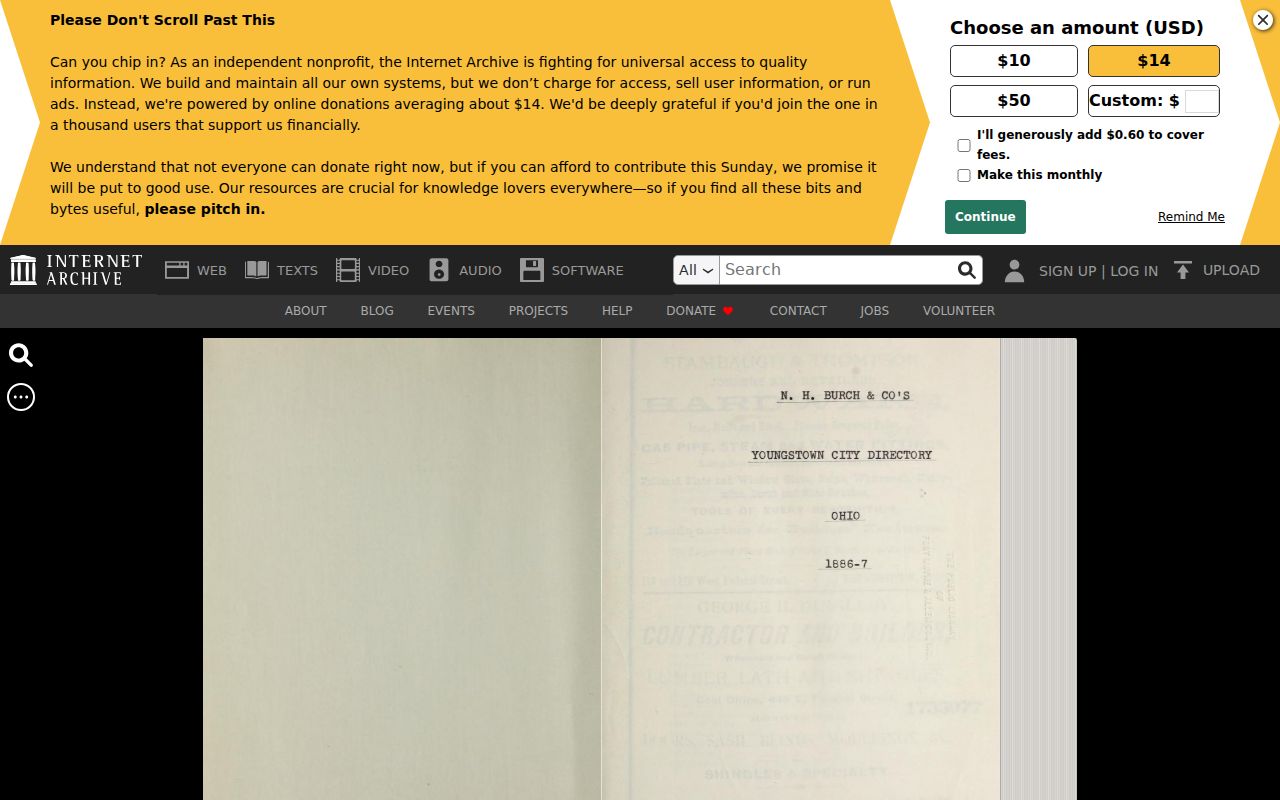
Do not infer a household’s exact move date from one printing. The volume shows that the publisher placed an entry in that edition’s compilation period. A different annual edition, a deed, an obituary, or a census can test the lead.
Youngstown Directory Research Routes
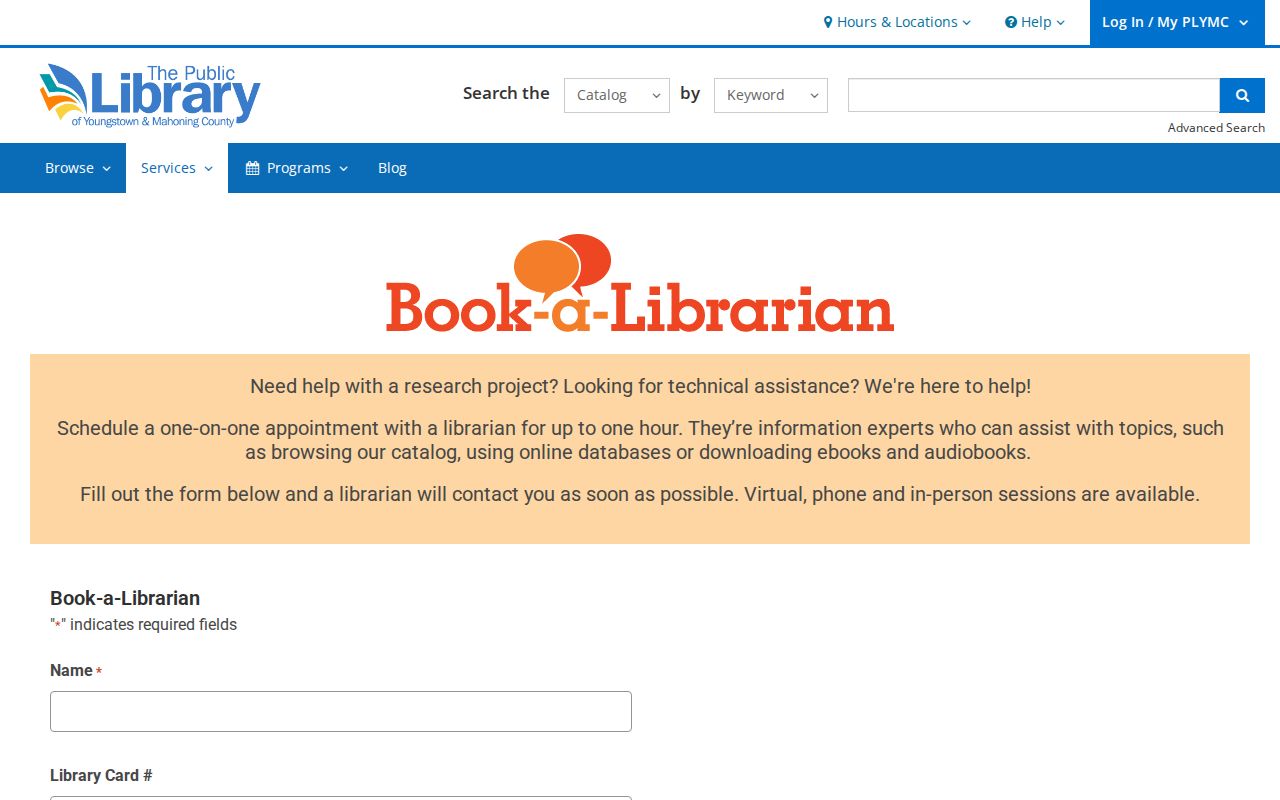
PLYMC is the practical first call for a focused question. Its genealogy route points researchers to local-history help, digitized material, newspapers, maps, and licensed in-library databases. For a difficult house or family question, the Book-a-Librarian service provides an appointment route. Bring the address, approximate era, names already located, and the desired source. That gives staff a usable request instead of asking them to assemble a biography.
The PLYMC research appointment page shows the Youngstown city directory assistance route.
MVHS is the companion archive for directories, telephone books, maps, and related local material. Its collection access is arranged with the society. MVHS reports a research service at $25 per hour after the first 15 minutes, free for members, with copies priced separately and possible backlogs of weeks. Ask about the exact directory year, whether a criss-cross volume exists, and whether a title covers Youngstown alone or surrounding places.
Read a Youngstown Directory Entry
Read the front matter before copying an entry. In the inspected 1886-87 volume, a person or business name is followed by a compact mix of occupation or business, residence address, and sometimes a spouse or widow notation. The street section reverses the route by street and number. A record can be useful even when it is brief, provided the edition and page are preserved with the transcription.
| Name or business | The indexed person or business as printed, including initials and spelling. |
|---|---|
| Occupation or business | A trade, role, or business description that can distinguish like-named entries. |
| Residence address | The printed house number and street, subject to the edition’s date and address conventions. |
| Relationship notation | A spouse or widow shorthand when the entry provides one. |
| Street section | The reverse street-and-number route used to locate an indexed name in the alphabetical portion. |
- Criss-cross directory
- A selected-year directory arranged by address, useful for moving from a number and street to the directory-listed person or business.
- Householder index
- An index that identifies a household head when a particular title includes one; confirm the volume’s own arrangement first.
- Abbreviation key
- The publisher’s explanation of shortened terms such as “res.” for residence and “bds.” for boards.
The abbreviation key prevents an easy error. “Bds.” signals a person boarding at the printed place, while “res.” marks residence. Neither notation proves ownership, every household member, or a later address.
Youngstown Directory Late Changes
The 1886-87 volume has a useful Youngstown quirk: late names and changes are directed to “Too Lates, Alterations and Removals.” Check that material when an expected name is missing from the main alphabetical section or when an address seems inconsistent. It is a publisher’s correction trail, not an invitation to combine entries without checking pages and abbreviations.
Spelling also needs patience. PLYMC’s genealogy guidance notes that early vital reporting was inconsistent and that WPA workers indexed older ledgers to cards in the 1930s. Directory indexing and historical transcriptions can show the same sort of variation. Search a likely spelling and a realistic variant, then keep the original printed form in the citation.
Note: A missing listing can mean a late change, a spelling variation, a different residence, or no inclusion in that edition.
Trace Youngstown Directories
A household trail works best when each source answers a narrow question. A reverse or criss-cross title can connect an address to a directory-listed name. The alphabetical portion can then add the printed occupation, relationship shorthand, and address. Nearby editions test whether the appearance is stable, while a released federal census supplies a dated household snapshot. Federal census releases follow a 72-year schedule, so identify the census year rather than assuming the latest one is public.
- Find the closest confirmed directory year for the person or address.
- Copy the entry exactly, including the edition, publisher, page, abbreviations, and street form.
- Check nearby annual editions for a move, spelling shift, relationship notation, or changed description.
- Use a selected criss-cross volume to compare the address with the alphabetical listing.
- Pair the sequence with the nearest released census, deed, probate, newspaper, or obituary evidence.
A disappearance has several possible explanations. The person may have moved, died, appeared under a variant spelling, or been omitted. Newspapers and obituaries can provide dates and relatives, but they need a source and date. Probate records can add estate context. Neither source alone confirms a present address.
Youngstown Directory Companions
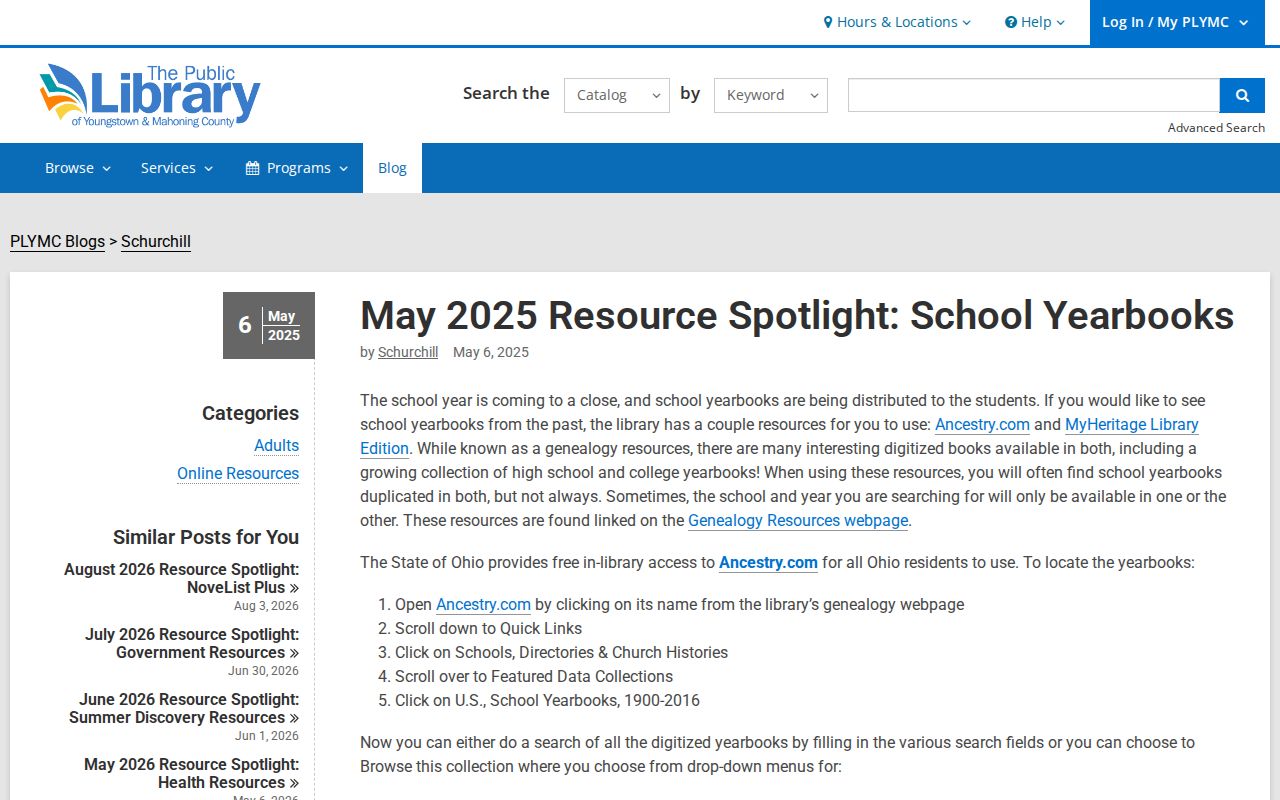
Directories are not the only local name source. PLYMC’s May 2025 yearbook guidance says Ohio residents can browse yearbooks through in-library Ancestry, and PLYMC cardholders can use MyHeritage for United States yearbooks from 1890-1979. Local schools may appear under both a township and “Youngstown,” so try both place labels. A yearbook can establish a school-year connection; it does not resolve later residence.
PLYMC’s school yearbook guidance documents this companion route for Youngstown city directory research.
YSU Archives and Special Collections offers another local context route. Its Oral History Collection, begun in 1974, has more than 1,100 interviews about Mahoning Valley communities and institutions. It can help frame a family or community story, but it is not a current-resident search tool.
Youngstown Directory Maps and News
When a directory address predates modern parcel systems, Sanborn maps can put it in a dated physical setting. MVHS and PLYMC identify map resources for Youngstown. A Sanborn sheet can show structures, materials, footprints, and street names at the survey date. It cannot name a household, so pair it with the directory, a deed, or another dated source rather than treating the map as a person record.
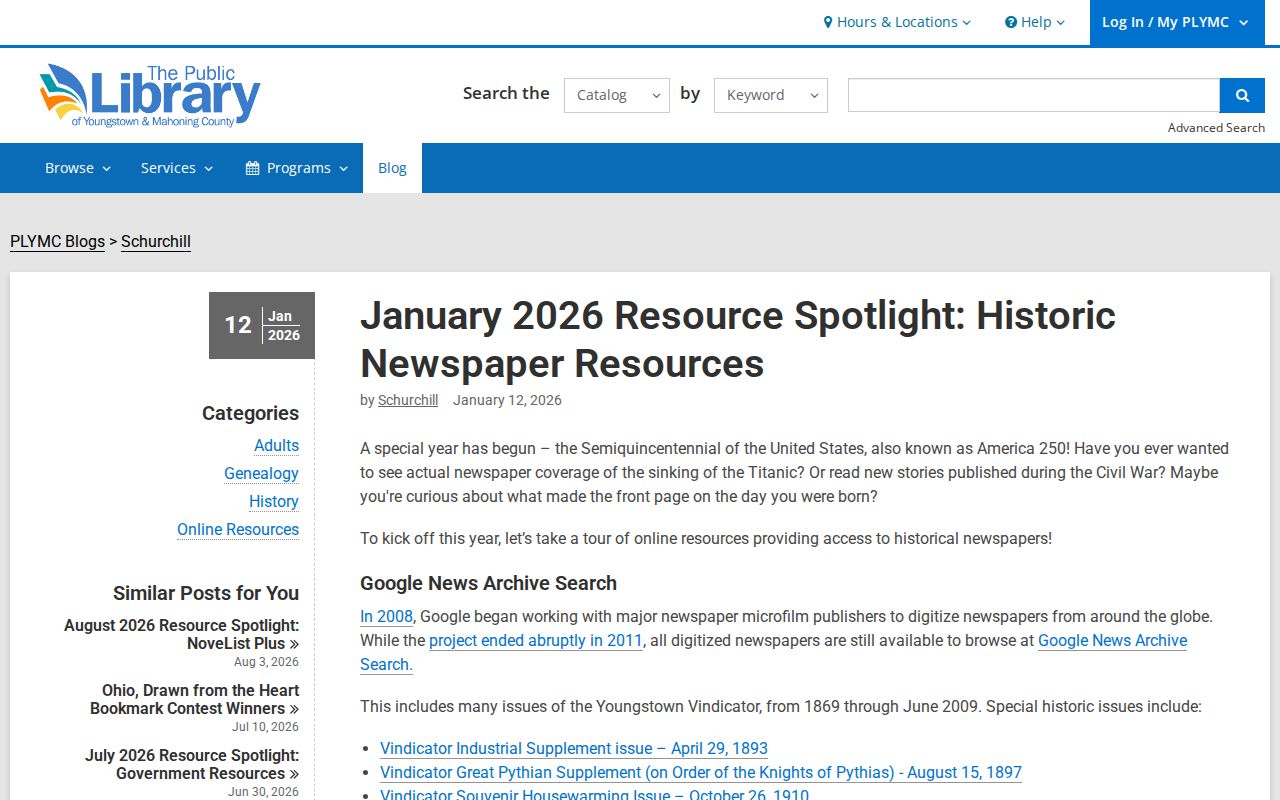
PLYMC’s January 2026 historic-newspaper update describes microfilm runs for the Youngstown Vindicator from June 25, 1869 through April 30, 2019, the Youngstown Telegram from 1887 through July 2, 1936, Steel Valley News from September 7, 1964 through April 11, 1965, and Valley Voice from November 19, 2004 through August 4, 2005. It cautions that Vindicator digitization is incomplete or poor in places. PLYMC can be reached at 305 Wick Ave., 330-744-8636, or ASK@libraryvisit.org for a particular issue or date.
The PLYMC historic-newspaper update shows the Youngstown city directory companion resources.
Youngstown Directory Era Checks
Youngstown-area research sometimes predates Mahoning County. The county was created February 16, 1846 from southern Trumbull and northern Columbiana County townships. Earlier land or probate evidence can therefore be in a parent-county source even when the present-day place is Youngstown. MVHS also identifies early government material and local land transactions that can help test a very early trail.
| 1869 | Earliest documented Youngstown directory holding at MVHS. |
|---|---|
| 1880-81 | Guthman & VanFleet directory example. |
| 1886-87 | N. H. Burch & Co. digitized example with alphabetical and street material. |
| Twentieth century | Burch Directory Company titles appear in local runs; verify each title and volume. |
There is no researched evidence of a records-loss event that should be used to explain a gap. The safer conclusion is narrower: consult the volume, repository, and related map or newspaper for the date at issue. That leaves the historical record intact without filling its gaps with assumptions.